How to Remove a Stuck Oil Filter (With or Without a Wrench)
To remove a stuck oil filter, grip it as close to the engine as you can and turn it counterclockwise, as seen from the bottom (closed end) of the filter. Bare hands rarely shift an overtightened filter, so add grip first (a rubber glove or sandpaper), then use a proper oil filter wrench. Punching a screwdriver through the can does work, but it is messy and risky, so treat it as the last resort, not the first move.
What you need
- A drain pan big enough for all the engine oil plus what's in the filter
- Nitrile or mechanic's gloves and eye protection (old oil drips straight down at your face)
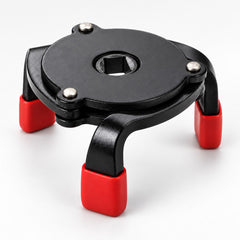
- An oil filter wrench, such as a 3-jaw oil filter wrench (60-95 mm), plus a 3/8-inch ratchet or breaker bar
- Clean rags, and a strip of coarse sandpaper or a rubber glove for the no-tool methods
- A jack, jack stands and wheel chocks if you need to raise the car
- The new filter, a new drain plug washer if your car uses one, and the correct oil from your owner's manual
Before you start: safety and setup
Work on a warm engine, not a hot one. Warm oil drains better, but right after a drive the oil, exhaust and filter can burn you, so let the car cool for a while first.
If you need to get under the car, lift it at the jacking points shown in your manual, then lower it onto jack stands on firm, level ground. Never work under a car held up only by a jack. Chock the wheels that stay on the ground.
Check what kind of filter you have. A spin-on filter is a metal can that screws onto a threaded stud on the engine. If your engine has a plastic or aluminum housing with a cap and a paper element inside, it's a cartridge filter. The cap comes off with a dedicated cap socket, and the wrench methods below don't apply.
How to remove a stuck oil filter step by step
Step 1: Make sure you're turning the right way
Imagine you're looking straight at the bottom of the filter. From that view, loosening is counterclockwise. The trap: many filters sit sideways or point up, and when you look at them from above, the correct direction feels backwards. A lot of "stuck" filters are actually being tightened.
Step 2: Add grip before you add force
- Wipe the filter clean and dry. An oily can is often the only reason your hand slips.
- Put on a rubber glove, or wrap a strip of coarse sandpaper around the can with the grit facing the metal.
- Grip near the base, where the can meets the mounting plate. The middle of the can is thin and dents easily. The base is much stiffer.
- Use a short, sharp twist rather than a slow strain. Once the seal breaks, the filter usually spins off by hand.
Step 3: Use an oil filter wrench
- Drain the engine oil first, then move the pan under the filter. The filter holds a fair amount of oil, and it runs out as soon as the seal breaks.
- Open the 3-jaw wrench and slide it over the end of the filter. Push it on as far toward the engine as it will go, so the jaws bite near the base.
- Fit your ratchet, set to loosen, or a breaker bar for more leverage.
- Pull steadily. The three jaws close in as you turn, so the harder you pull, the tighter they grip.
- When the filter cracks loose, take the wrench off and spin the filter the rest of the way by hand. Tip the open end up as it comes free to keep most of the oil inside, then empty it into the pan.
Step 4: Check that the old gasket came off
Look at the mounting face on the engine. The old rubber sealing ring should have come away with the filter. If it's stuck to the engine, peel it off. Screwing a new filter on over an old gasket (a "double gasket") is a classic cause of a sudden, heavy oil leak the moment the engine starts.
Oil filter wrench types compared
- Cap (cup) wrench: fits over the end of the filter like a big socket. Excellent grip, but it only fits the one filter size it was made for, and you need room for a ratchet at the end.
- Strap or band wrench: a metal band or a rubber or nylon strap that loops around the can. Cheap and adjustable, but it needs space around the filter to swing the handle, and a metal band can crush a thin can.
- 3-jaw wrench: adjustable over a range of sizes and driven from the end of the filter with a ratchet. It's a good choice when you can reach the bottom of the filter but can't get a strap or pliers around its sides. You do need clearance at the end for the jaws and ratchet.
- Pliers-type wrench: large adjustable jaws with a strong grip. You need room to swing the handles, and the teeth can pierce the can.
- Chain wrench: very strong grip for badly stuck filters, but it can tear a thin can.
If you only service one car, a cap wrench in the right size is hard to beat. For several cars, or a filter where only the end is reachable, an adjustable type is more useful.
The screwdriver method, and why it's a last resort
The old trick is to drive a long, sturdy screwdriver right through the filter can and use it as a lever. It can free a filter nothing else will move, but it has real downsides:
- Oil pours out of the holes, so drain the engine first and keep the pan right underneath.
- Thin sheet metal tears. If the screwdriver rips through the can, you lose your grip and are left with a shredded filter that's even harder to hold.
- If it tears badly, the steel base plate can stay threaded on the engine while the can comes away in your hand.
If you go this route, wear eye protection, punch the screwdriver through as close to the base as you can while staying clear of the engine block, push it all the way through both sides, and lever counterclockwise with steady pressure.
If you're left with only the base plate on the stud, you can sometimes grip its edge with large locking pliers and turn it off. Go gently: damaging the threaded stud or the sealing face on the engine turns a cheap job into an expensive one.
If it still won't budge
- Move the wrench closer to the base. Gripping the middle of the can tends to crush it rather than turn it.
- Use more leverage, not more speed. A breaker bar on the 3-jaw wrench gives steady, controlled force.
- Check clearance. Make sure the wrench or handle isn't jammed against a bracket or the subframe before you lean on it.
- Don't use an impact wrench. Hammering on a thin can usually just mangles it.
Fitting the new filter so it comes off next time
Most stuck filters were simply overtightened at the last oil change, usually with a wrench. Avoid passing the problem on:
- Wipe the engine's mounting face clean.
- Smear a thin film of clean engine oil on the new filter's rubber gasket. Don't use grease.
- Screw the filter on by hand until the gasket just touches the mounting face.
- Tighten further by hand as the filter maker instructs. Many specify about three-quarters to one full turn after gasket contact, and some print turn marks on the can. Follow what's on the box. The wrench is for removal, not for tightening.
- Refill with oil, start the engine and check around the filter and drain plug for leaks. Switch off, wait a few minutes, then check the oil level on the dipstick.
Take the old oil and filter to a recycling point. Never pour used oil down a drain.
When to call a pro
If the can has torn and the base plate won't move, if the threaded stud looks damaged, or if the filter sits where you simply can't get leverage on it, stop and get a shop to finish the job. Pulling a damaged stud or scarring the sealing face can mean an oil leak that's far more costly than a garage's time.
FAQ
Which way do you turn an oil filter to remove it?
Counterclockwise, as seen looking directly at the bottom (closed end) of the filter. Viewed from above, it can feel reversed.
Can you remove an oil filter without a wrench?
Often, yes. Clean the can, use a rubber glove or wrap it in coarse sandpaper, and grip near the base. If that fails, a wrench is the cleaner next step. The screwdriver method also works without a wrench, but it's messy and can leave you with a torn can.
Why is my oil filter so hard to get off?
Usually because it was tightened with a wrench last time, or the gasket wasn't oiled and bonded to the engine over many heat cycles.
What size oil filter wrench do I need?
Measure across the filter can or check the filter's specs. Cap wrenches fit one specific filter size only. Adjustable wrenches cover a range: the 3-jaw wrench fits most spin-on filters from 60 to 95 mm in diameter on cars and vans.
Should I use a wrench to tighten a new oil filter?
No, unless the filter maker's instructions say otherwise. Hand-tighten it by the amount printed on the filter or box. Overtightening is what makes the next filter change a fight.
Doing a full service? If the drain plug's head is chewed up, see how to remove a rounded bolt or nut, and while you're under the hood, changing your spark plugs is a good next DIY job.
Browse all engine service tools.