Dropped a Bolt in the Engine Bay? How to Get It Out
If you dropped a bolt in the engine bay, don't start the engine until you've found it. Most of the time it has landed on the plastic undertray, a subframe or a ledge low in the bay, and a bright light plus a telescopic magnet will get it back in a few minutes. If there's any chance it went into an open intake, a spark plug hole or the oil filler, read that section below before you do anything else.
What you need
- A bright flashlight or headlamp
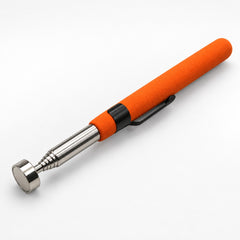
- A telescopic magnetic pickup tool (pen-sized, extends from 15 to 73 cm, about 6 to 29 inches)
- An inspection mirror, or your phone's camera with the flash on
- For nonmagnetic parts: a claw-type pickup tool, a shop vacuum with a narrow nozzle, or tape on a stick
- A jack, jack stands and wheel chocks if you need to look underneath
- Gloves
How to find and remove a dropped bolt step by step
Step 1: Stop and don't crank the engine
Don't start or crank the engine, and try not to rock or move the car. A bolt sitting on a ledge you can reach today can shift somewhere much worse. If you heard where it went (a clatter on plastic, a clink on metal, then silence), note it now while it's fresh.
Step 2: Make the bay safe to reach into
- Take the key out, or switch the car fully off on push-button cars.
- Let the engine cool. Exhaust manifolds and turbo housings stay hot enough to burn you long after you switch off.
- Keep fingers away from the radiator fan. On many cars the electric cooling fan can start by itself after the engine is off. If you'll be reaching near it, disconnect the battery.
- Keep hands clear of belts and pulleys, even with the engine off, in case someone turns the key.
Step 3: Search from above, systematically
- Shine your light straight down from where you were working and trace the path the bolt would have taken as it fell.
- Check the ledges and pockets along that path: the top of the transmission, the starter motor, brackets, wiring looms, the area where the engine meets the transmission, the subframe and the top of the steering rack.
- Use the mirror or your phone camera to see behind and under parts you can't get your head around.
- Remove anything that blocks your view and comes off easily, like a plastic engine cover or the airbox. That's often quicker than fishing blind.
Step 4: Fish it out with the magnet
- Extend the pickup tool to the length you need. Shorter is steadier.
- Lower the magnet slowly toward the bolt. You'll feel it snap on.
- Lift it out without banging it against anything. A knock can shake the bolt off.
- If the magnet keeps grabbing a steel bracket instead, slide it sideways off the bracket rather than pulling straight back, then approach the bolt from a different angle.
The magnetic head is rated at about 3.6 kg (8 lb), which is plenty for a bolt, nut, washer or socket. The pickup tool also fits in a pocket or glovebox, so it's worth keeping one in the car.
Step 5: Check from underneath
If it isn't visible from the top, it's very likely sitting on the engine undertray (splash shield), the large plastic or metal panel under the engine. Raise the front of the car with a jack, support it on jack stands on firm, level ground, and chock the rear wheels. Never go under a car held only by a jack. Look and feel along the undertray. Some have openings where you can reach in with the magnet. If not, the undertray is usually held on by screws and clips and can be lowered.
Step 6: Still nothing?
- Check the ground under the car, around your feet, your pockets and your toolbox. A surprising number of "lost" bolts never made it into the engine bay.
- Check the wheel arch liners and the top of the tire if you were working near the front corners.
- Sweep the magnet slowly across the floor where you were standing.
When the magnet won't pick it up
A magnet only picks up steel and iron. It won't lift aluminum, brass or stainless steel fasteners, or plastic clips. Before you spend ages fishing, test the magnet on a bolt like the one you lost. If it doesn't stick, switch methods:
- Claw pickup: a spring-loaded grabber with flexible fingers. Slower to aim, but it grabs any material.
- Shop vacuum: use a narrow nozzle or tape a smaller hose to it. Put a thin cloth over the nozzle so the part gets held against it instead of disappearing into the vacuum.
- Tape on a stick: a loop of strong tape, sticky side out, on the end of a dowel works for light parts on a flat surface.
- Take a part off: sometimes removing the airbox, a cover or the undertray is genuinely the fastest route.
If it fell inside the engine
This is the one situation where you must not start the engine to "see what happens". A loose bolt inside an engine can cause serious damage.
- Open intake or throttle body: a part in the intake can be drawn into a cylinder on start-up and damage the pistons and valves. If you can see it, try the magnet (if it's steel) or a vacuum with a small tube. If you can't see it, the intake may need to come off.
- Spark plug hole: don't crank the engine. A narrow magnet or a small vacuum tube can often retrieve it. If you can't confirm it's out, a shop can check with an inspection camera. If you were in the middle of a plug change, our guide on how to change spark plugs walks through the rest of the job.
- Oil filler: the part may be sitting on top of the valvetrain under the cover, or it may have dropped into the oil pan. If you can see it, try the magnet. If you can't, don't run the engine; the valve cover or oil pan may need to come off.
Replace the bolt you lost
If the bolt is gone for good, don't just leave it out. Every bolt in the engine bay is holding something, whether that's a heat shield, a bracket, a sensor or a component that vibrates. Get the right replacement: same diameter, thread pitch and length, and the same strength grade (the numbers stamped on the head, such as 8.8 or 10.9). Your dealer can supply the exact part by number. Some bolts are single-use by design, so check your service manual.
How to avoid dropping bolts in the first place
- Cover openings such as the intake, spark plug wells and oil filler with clean rags or tape as soon as you open them.
- Use a magnetic parts tray or a container for everything that comes off.
- Hold the bolt in the socket. A small strip of masking tape across the socket, or a dab of grease inside it, stops the bolt falling out while you guide it into a hole you can't see. For spark plugs, a magnetic spark plug socket holds the plug so it doesn't drop.
- Place parts with the magnet. The pickup tool can hold a nut or washer in position in a spot your fingers can't reach.
- Start threads by hand before you reach for a ratchet.
- Count bolts out and back in. Lay them out on a rag in the order they came off.
When to call a pro
If the part went into the intake, a cylinder or the oil system and you can't confirm it's out, get a shop to check before you start the engine. The same applies if the bolt is wedged near the timing cover, belts or other moving parts and you can't reach it safely. An inspection camera check costs far less than an engine repair.
FAQ
Can I drive with a bolt loose in the engine bay?
It's not worth the risk. A bolt on a ledge can fall into a belt, a pulley or the cooling fan once the engine runs and the car moves. If it's lying on the undertray it's less likely to cause harm, but get it out first anyway, and make sure whatever it came from is properly fastened.
What happens if a bolt falls into the engine?
It depends on where. In the intake or a cylinder, it can be drawn in and damage pistons and valves when the engine starts. In the oil system, it can interfere with moving parts. Don't start the engine until you know it's out.
How do I get a bolt out of a place I can't reach?
Use a telescopic magnet for steel bolts, a claw pickup for anything else, and a mirror or phone camera to see what you're doing. If neither reaches, remove the part in the way.
Why won't my magnet pick up the bolt?
It may be aluminum, brass or stainless steel, which a magnet won't lift. Test the magnet on a matching bolt. If it doesn't stick, use a claw pickup or a vacuum.
Do I need to replace a bolt I can't find?
Yes. Fit a replacement of the same size, thread pitch, length and strength grade. Check the service manual in case it's a single-use bolt.
Want to build a kit that covers jobs like this? See basic car tools every driver should own.
Browse all car tools.