Basic Car Tools Every Driver Should Own (Full Checklist)
Every driver should keep a small emergency kit in the car: a working spare tire (tyre) or inflator kit, the jack and wheel wrench, a tire pressure gauge, a tire plug kit, jumper cables or a jump starter, a flashlight, gloves and a warning triangle. If you do any of your own maintenance, add a metric socket set, screwdrivers, pliers, jack stands and a few job-specific tools at home. Here's the full list, with what each tool is actually for, so you buy what you'll use and skip what you won't.
What you need: the short version
- In the car: spare tire (or inflator kit), jack, wheel wrench, locking wheel nut key, tire pressure gauge, 12V inflator, tire plug kit, jumper cables or jump starter, flashlight, gloves, warning triangle, reflective vest and first aid kit.
- At home: a metric socket set, combination wrenches, screwdrivers or a bit set, pliers, a torque wrench, a jack with jack stands and wheel chocks, trim tools and a magnetic pickup tool.
- For when things go wrong: penetrating oil, a screw extractor set and a bolt extractor socket set.
Tools to keep in the car
Spare tire, jack, wheel wrench and locking nut key
These usually come with the car, but check that they're actually there. Many newer cars ship with a sealant and compressor kit instead of a spare. If your wheels have locking nuts, the key is the one piece you can't improvise: without it, you can't get the wheel off. Keep it with the jack, not in a drawer at home.
Tire pressure gauge and 12V inflator
Low pressure wears tires faster, hurts fuel economy and affects handling. The correct pressure for your car is on a sticker in the driver's door jamb, inside the fuel filler flap or in the owner's manual. The number molded on the tire's sidewall is the maximum the tire can hold, not what your car should run. Check pressures with the tires cold. A small 12V inflator that plugs into the car lets you top up anywhere.
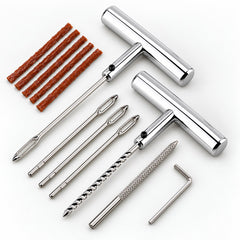
Tire plug kit
A plug kit lets you seal a nail or screw puncture in the tread of a tubeless tire at the roadside, often without removing the wheel. It's an emergency repair for tread punctures only: never for sidewall damage or large cuts, and you should have the tire checked by a professional afterwards. Our guide on how to plug a tire walks through it step by step.
Jumper cables or a jump starter
Cables are cheap but need a second car. A portable jump starter works on its own and is the better choice if you often park alone or drive at night. Whichever you pick, read the connection order in your car's manual before you need it.
Flashlight, gloves and visibility kit
A headlamp keeps both hands free for a wheel change in the dark. Work gloves protect your hands from hot, dirty or sharp parts. In many European countries, a warning triangle and a reflective vest are required by law, and some also require a first aid kit, so check the rules wherever you drive.
Tools for basic maintenance at home
A metric socket set
Most modern cars use metric fasteners, and 8, 10, 12, 13, 14, 17 and 19 mm cover a large share of jobs. Socket sets come in three common drive sizes:
- 1/4-inch drive: small fasteners and light jobs, such as interior trim, sensors, small brackets and engine covers.
- 3/8-inch drive: the general-purpose size for most under-hood work.
- 1/2-inch drive: high-torque jobs such as wheel nuts and suspension bolts.
Wrenches, screwdrivers and pliers
A set of metric combination wrenches (8 to 19 mm) reaches nuts where a socket won't fit. For screwdrivers, a bit set with Phillips, slotted, hex and Torx bits covers more cars than a drawer of single drivers. Add needle-nose pliers, slip-joint pliers and a pair of locking pliers.
Torque wrench
Wheel nuts, spark plugs and drain plugs all have a tightening spec in your manual. Too loose and parts can work free. Too tight and you stretch bolts or strip threads, especially in aluminum. A click-type torque wrench takes the guessing out.
Jack, jack stands and wheel chocks
The scissor jack in your trunk is for changing a wheel at the roadside, not for working under the car. If any part of your body goes under the car, it must be resting on jack stands on firm, level ground, with the wheels chocked.
Job-specific tools worth having
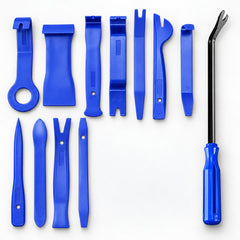
- Trim removal tools for door panels, dash trim, speakers and dash cams. Nylon won't scratch paint or trim.
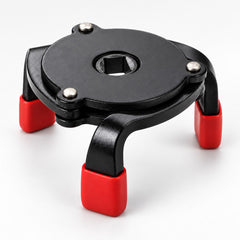
- An oil filter wrench, a drain pan and a funnel if you change your own oil.
- A spark plug socket in the right size for your engine (16 mm is common, but some engines use 14 mm, so check first).
- A telescopic magnetic pickup tool for the bolt that inevitably falls into the engine bay.
- A basic multimeter. A healthy, fully charged 12V battery reads about 12.6 volts at rest.
For when things go wrong
Penetrating oil and a wire brush help with rusty fasteners. A screw extractor set gets out screws with stripped heads, and a bolt extractor socket set grips rounded bolts and nuts that a normal socket slips on. You won't need them often, but when you do, nothing else does the job as well. Our guide on how to remove a rounded bolt or nut explains when to use which.
Is a 1/4-inch socket set enough?
For a lot of light jobs, yes. A 46-piece 1/4-inch socket and bit set includes a 24-tooth ratchet, 13 metric sockets from 4 to 14 mm, 21 screwdriver bits (slotted, Phillips, Pozidriv, hex and Torx T10-T40), extensions, a flexible extension, a sliding T-bar and a universal joint. That covers interior panels, trim screws, sensors, small brackets, airbox clamps, license plates and many headlight and engine-cover fasteners, and it fits in tight spots a bigger ratchet can't.
What it's not for: wheel nuts and suspension bolts. Those need a 1/2-inch drive tool and far more torque than a 1/4-inch ratchet should take. Think of the 1/4-inch set as your everyday kit, and add a 3/8- or 1/2-inch set for the heavier work.
Do universal sockets work?
Yes, for the right jobs. A universal socket is filled with dozens of spring-loaded steel pins that push back and take the shape of whatever you press it onto: hex nuts, square heads, wing nuts, hooks, eye bolts and worn or rounded heads. One tool covers a range of sizes (7-19 mm or 9-21 mm, depending on the version), and with the included adapter it fits a drill or a ratchet.
Where it falls short: seized or very high-torque bolts, and impact wrenches. Under heavy load the pins can't grip like a solid socket. So it's great for odd shapes and quick everyday jobs, but for a rounded bolt that's also rusted solid, use an extractor socket instead.
How to check your car's emergency kit
- Open the trunk floor and confirm you have a spare (or an inflator kit), the jack and the wheel wrench.
- Find the locking wheel nut key, if your car has locking nuts, and store it with the jack.
- Check the spare's pressure. Compact spares often need a higher pressure than your normal tires; it's printed on the spare or in the manual.
- Check that the 12V inflator works and its plug fits your car's socket.
- Test the flashlight and replace or charge its batteries.
- Check the first aid kit hasn't been raided and nothing has expired.
- Read the wheel-change and jump-start sections of your manual once, at home, in daylight.
Mistakes to avoid
- Buying by piece count. A huge kit full of sizes you'll never use is worth less than a smaller set with the right sizes and decent quality.
- Using the wrong drive size. A small ratchet on a wheel nut can break the tool and skin your knuckles.
- Trusting the scissor jack to hold the car while you work underneath. Use jack stands.
- Forgetting the locking nut key. It's the most common reason a simple flat turns into a tow.
- Never checking the spare. A flat spare is no spare.
When to call a pro
Good tools make basic jobs easy, but brakes, steering, airbags and anything that needs the car lifted beyond what you can safely support are worth leaving to a shop unless you have the knowledge and equipment. Tools help you do a job; they don't replace knowing the procedure for your car.
FAQ
What tools should I keep in my car at all times?
A spare or inflator kit, the jack and wheel wrench, your locking nut key, a tire pressure gauge, a tire plug kit, jumper cables or a jump starter, a flashlight, gloves, a warning triangle and a first aid kit.
What size socket set do I need for a car?
A metric set covering roughly 8 to 19 mm handles most jobs on modern cars. A 3/8-inch drive is the best all-rounder, with 1/4-inch for small fasteners and 1/2-inch for wheel nuts and suspension.
Do universal sockets work?
Yes, on odd shapes, wing nuts, hooks and worn heads at moderate torque. They're not designed for seized bolts or impact wrenches.
Is a 1/4-inch socket set enough for car work?
For interior and light under-hood jobs, yes. For wheel nuts and suspension bolts, you need a 1/2-inch drive tool.
Do I need a torque wrench?
If you change wheels, spark plugs or oil yourself, it's strongly recommended. Your manual gives the torque specs, and a torque wrench is the only reliable way to hit them.
Browse all car tools.