How to Plug a Tire With a Plug Kit (Step by Step)
To plug a tire (tyre), find the puncture, pull out the nail or screw, clean the hole with the spiral reamer, push a rubber repair strip in with the insertion needle, then pull the needle straight out and trim the ends. It only works on small punctures in the tread, and it's an emergency repair: once you're rolling again, have the tire inspected and properly repaired by a tire shop.
What you need
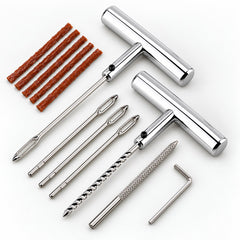
- A tire plug kit with a spiral reamer, an insertion needle and rubber repair strips, such as the tire plug repair kit with T-handles
- Rubber cement (optional but better). Many repair strips are self-vulcanizing, but cement gives a stronger seal
- Pliers to pull out the nail or screw
- Air: a 12-volt compressor or a gas station air pump, plus a tire pressure gauge
- A sharp utility knife to trim the plug
- A spray bottle of soapy water to find the leak and check your repair
- Gloves and eye protection
- If you need to take the wheel off: jack, jack stands, wheel chocks and a lug wrench
First, check that the tire can be plugged
A plug is only a sensible fix when every one of these is true:
- The hole is in the tread. That's the flat part that touches the road. Never plug the sidewall or the shoulder, the rounded edge where the tread turns into the sidewall. Tire industry guidance limits repairs to the tread area for good reason: the sidewall flexes constantly and a repair there won't hold.
- The hole is small. The industry limit for repairing a puncture is 1/4 inch (6 mm) across. A typical nail or screw is smaller than that. A cut, a slit or a torn gash is not a plug job.
- The tire wasn't driven flat. Driving even a short distance on a completely flat tire can damage it inside, where you can't see it. If you drove on it flat or very low, fit the spare and have the tire inspected instead.
- It's a tubeless tire. Almost all modern car tires are. Plug kits don't work on tires with an inner tube.
- It isn't a run-flat, or the maker allows repairs. Many tire makers restrict or forbid repairs on run-flat tires. Check before you plug one.
- There's enough tread left. A tire that is already at or near the legal wear limit should be replaced, not repaired.
If any of these fail, use your spare or call for roadside help.
Safety before you start
- Get well away from traffic, switch on your hazard lights and set the parking brake. Chock the wheel diagonally opposite the flat one.
- If the puncture faces traffic and you can't move somewhere safer, don't kneel there. Call for help.
- If you lift the car, use the jacking point shown in your manual and support it on a jack stand. Never put any part of your body under a car held up only by a jack.
- Wear eye protection. The reamer and needle need real force, and grit can flick out of the hole.
- If you're not ready to plug the tire yet, leave the nail in. It usually slows the leak.
How to plug a tire step by step
Step 1: Find the puncture
- Put some air in the tire so you can hear and feel the leak.
- Look for a nail or screw head in the tread. Roll the car forward a little if part of the tread is hidden against the ground.
- If you can't see anything, spray soapy water over the tread and watch for growing bubbles.
- Mark the spot with chalk or a marker, and note the angle the object went in at. You'll ream and insert along that same angle.
Step 2: Remove the object
Pull the nail straight out with pliers. Back a screw out by turning it counterclockwise instead of yanking it. The tire will start losing air now, which is normal. Work steadily through the next steps so it doesn't go completely flat.
Step 3: Ream the hole
- Push the spiral reamer into the hole at the same angle the object went in. It takes a firm push.
- Work it in and out several times. This cleans out debris and roughens the rubber so the plug can grip.
- Don't lever the reamer sideways. You want a clean channel, not a bigger hole.
- Leave the reamer in the hole while you load the plug, so you don't lose the spot.
Step 4: Load a repair strip
Thread one rubber strip through the eye of the insertion needle and center it, so both ends are about the same length. If you have rubber cement, coat the strip now.
Step 5: Insert the plug
- Pull the reamer out and immediately push the loaded needle into the hole, at the same angle.
- Use steady, firm pressure on the T-handle. It takes more force than most people expect.
- Stop when roughly a third of each end is still sticking out. Don't push the whole strip inside. If your kit gives an insertion depth, follow it.
Step 6: Pull the needle out
Pull the needle straight out in one quick, firm motion, without twisting, unless your kit's instructions say otherwise. The needle's open eye lets go of the strip and leaves it folded in the hole.
Step 7: Trim, inflate and check
- Cut the ends roughly level with the tread. Don't pull on them while you cut.
- Inflate the tire to the pressure on the sticker in the driver's door jamb (or in your manual), not the maximum printed on the sidewall.
- Spray soapy water over the plug. A few small bubbles may settle quickly. Steady, growing bubbles mean it hasn't sealed.
Step 8: Recheck and get it inspected
Drive gently at moderate speed, check the pressure again after a few miles and again the next day. Then take the tire to a shop. The tire industry does not treat a plug on its own as a proper repair, because the tire hasn't been taken off the wheel and checked inside. Depending on what the inspection finds and the shop's policy, they'll either do a permanent repair or tell you the tire needs replacing. The details are in our guide to tire plug vs patch.
If the plug won't seal
- The needle won't go in. Ream the hole a few more times and keep the angle straight. A dab of rubber cement on the strip helps it slide.
- The plug came back out with the needle. You probably pulled slowly or twisted. Load a fresh strip and try again.
- Air hisses past the plug. The hole may be bigger than you thought, or the plug went in at the wrong angle. Don't keep stuffing strips in. Fit the spare.
- A slow leak a day or two later. Spray the plug, the valve and the edge of the rim with soapy water. Whatever the source, it's time for the shop.
Mistakes to avoid
- Plugging the sidewall or shoulder. It's not repairable, with a plug or anything else.
- Plugging a tire that was driven flat. The hidden damage is the danger, not the hole.
- Skipping the reamer. An unprepared hole seals poorly.
- Treating the plug as permanent and forgetting about it.
When to call a pro
Call roadside assistance or a tire shop if the damage is anywhere near the sidewall, the hole is bigger than 1/4 inch, the tire has come off the rim's bead, you drove on it flat, or you're on a busy road with no safe place to work. And even after a perfect plug, a shop should look at the tire soon.
FAQ
Can you plug a tire with a nail in it?
Yes, if the nail is in the tread and the hole is no bigger than 1/4 inch (6 mm). Leave the nail in until you're ready, then pull it, ream the hole and plug it straight away.
Can you plug a tire without taking it off the car?
Often, yes. If you can reach the puncture, roll the car until the hole is easy to get at. If it's hard to reach, lift the car, support it on a jack stand and remove the wheel. A permanent repair always needs the tire taken off the wheel, which is the shop's job.
How long can you drive on a plugged tire?
There's no reliable mileage figure. Major tire makers, Michelin among them, say a roadside plug is not a permanent fix. Some plugs hold air for a long time, but without an inside inspection you can't know whether the tire is sound. Get it checked as soon as you reasonably can.
Do you need rubber cement for a tire plug?
Not always. Many strips are self-vulcanizing and seal without it, but cement gives a stronger seal. The JUSMIR kit doesn't include a glue tube, so add one if you want it.
Can you plug a motorcycle tire?
The kit is made for tubeless tires on cars, motorbikes, quads and bikes, and the same rules apply: tread only, small hole, inspection afterward. On two wheels a tire failure is far more dangerous, so ride gently and get the tire checked or replaced quickly.
Keeping a plug kit in the trunk is one of the cheapest ways to avoid being stranded. See which other tools are worth carrying in basic car tools every driver should own, or grab the tire plug kit for your glovebox.
Browse all tire and roadside tools.