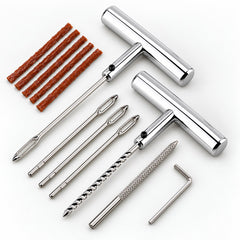
Tire Plug vs Patch: Which Repair Is Safe and When
A tire (tyre) plug fills the hole from the outside; a patch seals the inner liner from the inside. The repair the tire industry accepts as permanent uses both together, a plug-patch combination, fitted after the tire has been taken off the wheel and inspected. A plug on its own is a useful emergency fix that gets you moving, but it isn't a permanent repair, so plan to get the tire checked.
What you need
- For a roadside fix: a plug kit such as the tire plug repair kit with T-handles, a tire pressure gauge and a way to add air (a 12-volt compressor or gas station pump).
- For a permanent repair: a tire shop. A proper plug-patch repair means taking the tire off the rim, inspecting it inside and bonding the patch to the inner liner, which needs shop equipment.
Plug vs patch at a glance
| Plug only | Patch only | Plug-patch combination | |
|---|---|---|---|
| Fitted from | Outside, tire on the wheel | Inside, tire off the wheel | Inside, tire off the wheel |
| Fills the hole | Yes | No | Yes |
| Seals the inner liner | No | Yes | Yes |
| Tire inspected inside | No | Yes | Yes |
| Industry view | Emergency or temporary | Incomplete | Proper permanent repair |
What a tire plug is
A plug is a sticky rubber strip that you force into the puncture from outside with an insertion needle, after cleaning the hole with a spiral reamer. It fills the hole and stops the leak, and you can do it at the roadside in a few minutes without taking the tire off the car. Our step-by-step guide on how to plug a tire walks through it.
The catch is what a plug can't do. Nobody has looked inside the tire, so any damage on the inside goes unseen. And the plug only fills the channel, it doesn't seal the airtight inner liner the way a patch does.
What a tire patch is
A patch is a rubber piece bonded to the inside of the tire over the injury. To fit one, a shop removes the tire from the wheel, cleans and buffs the inner liner around the hole, and cements the patch in place.
A patch alone has the opposite weakness to a plug. It seals the inside, but the hole through the tread stays open. Water and road grit can get into that channel and reach the steel belts inside the tire, where moisture can cause rust and loosen the patch over time.
The plug-patch combination: what the industry recommends
Tire makers and their industry bodies agree on the method. The U.S. Tire Manufacturers Association (USTMA) says a repair has to fill the injury and seal the inner liner, and it calls a plug alone an unacceptable repair. Michelin, for example, requires a combined plug and inside patch on its tires, with the tire removed from the wheel for inspection first.
The combination does both jobs. The plug part (often a rubber stem built into the patch as one unit) fills the hole and keeps moisture out of the casing. The patch part seals the liner and holds everything in place. Shops that follow this method describe it as a repair that can last for the life of the tire.
The inspection matters as much as the materials. A tire that has run low on air can be damaged inside while looking normal outside, and only a technician looking at the inner liner can tell. That's the main reason a permanent repair can't be done from outside.
Is plugging a tire safe?
As an emergency repair, on a small puncture in the tread, done carefully with a proper kit, a plug is a widely used way to get you to a tire shop instead of waiting at the roadside. Check the pressure regularly and drive gently until the tire has been inspected.
What makes it risky is treating it as finished. A plug can work loose over time, and any hidden damage inside stays hidden. Tire makers don't treat it as a permanent repair, and neither should you.
Don't plug a tire at all if the hole is in the shoulder or sidewall, larger than 1/4 inch (6 mm), a cut rather than a puncture, or if you drove on the tire while it was flat.
How long does a tire plug last?
There's no honest mileage number. Some plugs hold air for a long time, others start leaking within days, and you can't tell from the outside which kind you have. The sensible plan is to treat a plug as a way to reach a shop, then get the tire inspected and repaired properly as soon as you reasonably can.
One more reason not to wait: USTMA guidance says a tire that already has an improper repair should not be repaired again, but taken out of service. Shops differ in how they apply that to a recent roadside plug, so depending on the inspection and the shop's policy, a plugged tire may get a proper plug-patch repair, or you may be told it needs replacing. Tell the shop the tire has been plugged.
When a tire can't be repaired at all
Neither a plug nor a patch is the right answer in these cases. The tire needs replacing:
- The damage is in the sidewall or reaches into the shoulder
- The puncture is bigger than 1/4 inch (6 mm) across
- The tire was driven flat or badly underinflated and is damaged inside
- There's a cut, tear, bulge or exposed cords
- A new repair would overlap an old one
- The tread is at or near the legal wear limit
- It's a run-flat tire whose maker doesn't allow repairs (policies vary by brand, so check)
Tire makers set their own limits on top of the industry basics, such as how many repairs a tire may have or what happens to a speed rating after a repair. In the UK, repairs are covered by the British Standard BS AU 159, which also caps punctures at 6 mm, restricts repairs to the central part of the tread and doesn't cover outside plugs meant for temporary use.
Common mistakes
- Driving for months on a roadside plug. It was meant to get you to a shop.
- Accepting a plug-only repair at a shop. Ask whether they'll take the tire off the wheel, inspect it inside and fit a plug-patch.
- Plugging the shoulder because it "looks close enough". If there's any doubt that the damage reaches the shoulder, the tire should come out of service.
- Ignoring a tire that ran flat. The hole is the obvious damage. The hidden damage is the one that matters.
When to call a pro
For the permanent repair, always. A tire shop can dismount the tire, inspect the inside, decide whether it's repairable and fit a plug-patch if it is. Call roadside assistance instead of plugging it yourself if the damage is near the sidewall, the tire was driven flat, or there's no safe place to work.
FAQ
Is a plug or a patch better?
Neither is complete on its own. A plug fills the hole but leaves the inside unsealed and uninspected. A patch seals the inside but leaves the hole open to moisture. The proper repair combines both, fitted by a shop with the tire off the wheel.
Is it safe to drive on a plugged tire?
For a short time, to get to a shop, a correctly installed plug in a tread puncture is a reasonable emergency fix. Check the pressure, drive gently and get the tire inspected soon. Don't treat it as permanent.
Can a tire shop patch a tire that's already been plugged?
It depends on the shop and the tire. The shop will inspect it inside first. Some shops follow the industry guidance strictly and replace any tire with a plug-only repair. Others will remove the plug and fit a proper plug-patch if the tire is otherwise sound.
Can you patch a tire sidewall?
No. Industry guidance limits repairs to the tread area. Sidewall damage, or damage that reaches into the shoulder, means the tire needs replacing.
How many times can a tire be repaired?
Repairs must not overlap, and tire makers set their own limits on the number of repairs, which vary by brand and tire type. Ask the shop, or check the tire maker's repair policy.
Not sure what to keep in the car for emergencies? See basic car tools every driver should own, or keep a tire plug kit in the trunk for the day you need it.
Browse all tire and roadside tools.