How to Change a Flat Tire Step by Step
To change a flat tire (tyre), stop somewhere safe, set the parking brake, loosen the lug nuts while the wheel is still on the ground, lift the car at the jacking point shown in your manual, then swap the flat for the spare. Tighten the nuts in a star pattern, lower the car, tighten them fully and check the spare's pressure and speed limit before you drive on.
What you need
- Your spare tire, inflated (check it's there: many newer cars carry a sealant and compressor kit instead)
- The car's jack and wheel wrench (lug wrench)
- The locking wheel nut key, if your wheels have locking nuts
- Your owner's manual, for the jacking points, the spare's limits and the lug nut torque
- Wheel chocks, or a couple of large rocks or bricks
- Gloves, a flashlight or headlamp, and a warning triangle and reflective vest if you carry them
- A small, sturdy board to put under the jack on soft ground
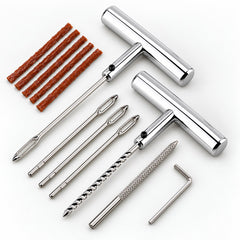
- Optional: a tire plug kit, which can seal a nail or screw hole in the tread without changing the wheel (see below)
Safety first
- Get well off the road, onto firm, level ground. If the tire is already flat, keep going slowly to a safe spot: a ruined wheel is better than working beside fast traffic.
- Hazard lights on, engine off, parking brake on, and the car in Park (automatic) or in gear (manual).
- Everyone out and well away from the road, behind a barrier if there is one.
- Chock the wheel diagonally opposite the flat one, so the car can't roll.
- Set out a warning triangle if you have one. Many countries require you to carry one.
- Know when not to. If the flat side faces fast traffic or the ground is soft or sloped, call roadside assistance.
- Never put any part of your body under a car held up only by a jack.
Change the wheel or plug the tire?
If the tire went down because of a nail or screw in the tread, it hasn't been driven flat, and you have a plug kit and a way to inflate the tire, a plug can get you moving, often without lifting the car. It's an emergency repair for tread punctures only, and a shop should check the tire afterward. Our guide on how to plug a tire covers the checks and the steps. For a sidewall cut, a blowout, a tire you drove on while flat, or any doubt at all, fit the spare.
How to change a flat tire step by step
Step 1: Get the spare out and remove the wheel cover
The spare, jack and wrench usually live under the trunk floor. Lay them where you can reach them without stepping toward traffic. Pry off any hubcap or plastic nut caps with the flat end of the wheel wrench; some covers are held on by the lug nuts and come off with the wheel.
Step 2: Loosen the lug nuts
- Fit the wrench fully onto a nut. Use the locking nut key on the locking nut.
- Turn each nut counterclockwise about half a turn. Don't remove them yet.
- If a nut is tight, set the wrench roughly horizontal and push down with your body weight, or press with your foot. Keep your balance and don't jump on it.
- Loosen every nut before you lift the car. With the tire on the ground, the road stops the wheel spinning while you turn.
Step 3: Find the jacking point
Your manual shows exactly where the jack goes. On many cars it's a reinforced section of the seam under the door sill, just behind the front wheel or just in front of the rear wheel, often marked with a notch or an arrow. Never jack on plastic sill covers, the floor pan or suspension parts.
Step 4: Raise the car
- Seat the jack's head squarely in the jacking point and wind it up until it just takes the weight. Check the jack is upright.
- Keep raising until the flat tire is clear of the ground, then a little more: the inflated spare is taller than the flat.
Step 5: Remove the flat
- Unscrew the nuts the rest of the way and put them where they can't roll off, such as the upturned hubcap.
- Grip the tire at both sides and pull the wheel straight toward you.
- Lay the flat under the sill next to the jack. If the jack slips, the car lands on the tire, not the ground.
Step 6: Fit the spare
- Lift the spare onto the studs, lining up the holes, with the valve stem facing out.
- Thread every nut on by hand first, tapered side toward the wheel, so none cross-thread.
- Snug them with the wrench in a star pattern (see below), but don't fully tighten them yet: the wheel would just turn.
If your car uses wheel bolts instead of nuts, as many European cars do, line the wheel up and start one bolt at the top first, so the wheel hangs in place while you thread the others.
Step 7: Lower and tighten
- Lower the car until the spare touches the ground and takes some weight.
- Tighten the nuts firmly, in the star pattern.
- Lower the car fully and remove the jack.
- Go around once more in the star pattern, tightening each nut firmly.
Step 8: Pack up and check
Put the flat, the jack and the tools back in the trunk and secure them so nothing slides around. Check the spare's pressure with a gauge as soon as you can.
Lug nut order: the star pattern
Never tighten lug nuts one after another around the circle. Tighten one, then the one roughly opposite, and keep crossing the wheel, so it pulls flat against the hub evenly. Numbering the nuts clockwise:
- 4 nuts: 1, 3, 2, 4 (opposite pairs)
- 5 nuts: 1, 3, 5, 2, 4 (skip one each time, which traces a star)
- 6 or 8 nuts: work in opposite pairs, moving around the wheel
Do two or three passes, getting tighter each time, rather than fully tightening the first nut before the others are snug.
Torque it and check again
The wheel wrench gets the nuts tight enough to drive on, but it can't measure torque. As soon as you can, set them with a torque wrench to the figure in your owner's manual, in the star pattern. Then recheck after a short distance, with the wheels cool, because a wheel can settle against the hub. Continental, for example, says to check lug nuts after about 50 km (30 miles) when new tires have been fitted; your manual may give its own figure.
Driving on the spare
- Check its pressure. Compact spares (space-saver or "donut" spares) often need far more air than your normal tires, commonly 60 psi (420 kPa). The right figure is on the spare's sidewall, a label on the wheel, or in your manual.
- Respect its limits. A compact spare is built for short, gentle trips, and many are limited to 50 mph (80 km/h). The speed and distance limits for yours are printed on the spare or in your manual. Stick to them.
- Drive gently. A narrower spare can affect braking and handling.
- Expect warning lights. The TPMS light may stay on if the spare has no pressure sensor. Some all-wheel-drive cars have extra rules in the manual for driving on a compact spare.
- Sort out the flat soon, and put the spare back inflated and ready for next time.
If something goes wrong
- A lug nut won't budge. Check you're turning counterclockwise with the wrench fully on the nut, and use your body weight. A 1/2-inch drive breaker bar gives far more leverage than a short factory wrench. Never put a small 1/4-inch ratchet on a wheel nut: it isn't built for that torque.
- A nut is rounded, or the locking key is missing. Stop before you make it worse and call roadside assistance or a tire shop.
- The wheel is stuck to the hub. Rust can glue a wheel on. Thread two nuts back on a few turns so it can't fall off, then strike the tire's sidewall with a rubber mallet, working around it, but never so hard the car moves on the jack.
- The jack is sinking or tilting. Lower the car straight away, put a board under the jack or move to firmer ground, and start again.
- The spare is flat too. Inflate it if you carry a 12-volt inflator. Otherwise, call for help.
When to call a pro
Call roadside assistance if you're on a busy road with no safe place to work, the ground is soft or sloped, the nuts won't come off, the locking key is missing, you can't find the jacking points, or you simply don't feel safe doing it. There's no prize for changing a tire beside fast traffic.
FAQ
Do you loosen lug nuts before jacking up the car?
Yes. Loosen them about half a turn while the tire is still on the ground, so the wheel can't spin. Then lift the car and remove them completely.
Which way do you turn lug nuts to loosen them?
Counterclockwise, on almost every car. A few older vehicles used left-hand threads on one side of the car, usually marked with an L on the stud.
How fast and how far can you drive on a spare tire?
A compact spare has speed and distance limits printed on its sidewall or in your manual, often 50 mph (80 km/h). Use it only to get to a tire shop. A matching full-size spare can usually be driven normally once you've checked its pressure.
Can you change a tire without a jack?
Not safely, so don't try to lift the car any other way. If the problem is a nail or screw in the tread, a plug kit may get you going without lifting the car at all. Otherwise, call roadside assistance.
For what to keep in the trunk, see basic car tools every driver should own.
Browse all tire and roadside tools.